

Chokepoints & Shipping, More Important Than You Think
The critical passages of the world and what goes through them

Why Does Shipping Matter?
Outside of how you get your one-day amazon buys and temu orders, shipping is an incredibly important concept. On any given day, there’s anywhere from 50,000 to 100,000 ships at sea. Over 900 established shipping lanes, 361 trillion square meters of water, it’s hard to comprehend the scale of shipping.
Its scale is a result of its importance, and for the first time in maritime history, both major Middle East maritime corridors are simultaneously blocked or threatened. In this article I want to look at what impact that has on the materials you, I, and everyone else uses on a daily basis.
The Map
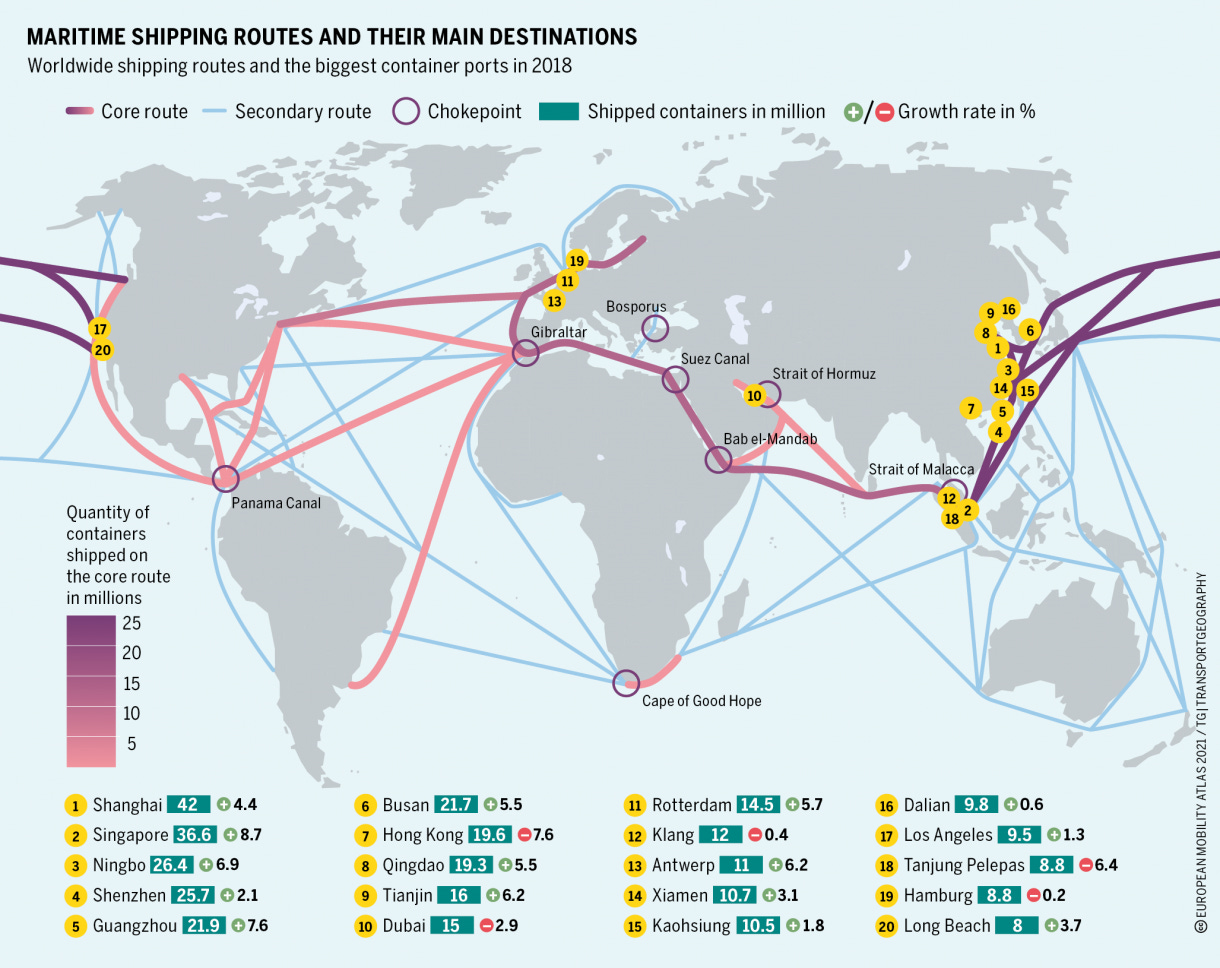

The four major chokepoints that govern global dry bulk (stuff that isn’t oil) flows are as follows:
Strait of Hormuz: The waterway between the Persian Gulf and the Gulf of Oman. Currently closed, previously responsible for a fifth of the worlds oil and 5% of global dry bulk.
Bab el-Mandeb: Located between Yemen on the Arabian Peninsula and Djibouti and Eritrea in the Horn of Africa, connecting the Red Sea to the Gulf of Aden and by extension the Indian Ocean. Currently threatened by Yemeni Houthi rebels funded by the Iranian regime.
The Suez Canal: A 193 km (120 miles) sea-level waterway in Egypt that connects the Mediterranean Sea to the Red Sea which handles a third of all global traffic as it cuts shipping time by two weeks via avoiding the cape of good hope.
The Panama Canal: An 82-kilometer (51-mile) artificial waterway in Panama that connects the Caribbean Sea and the Pacific Ocean. Saves around 15,000km in travel and handles 5% of all global trade daily.
Iron and Coal
What I want to focus on is not oil & gas, but dry bulk. That means the raw materials that drive the world. The anchor cargo of those is iron ore.
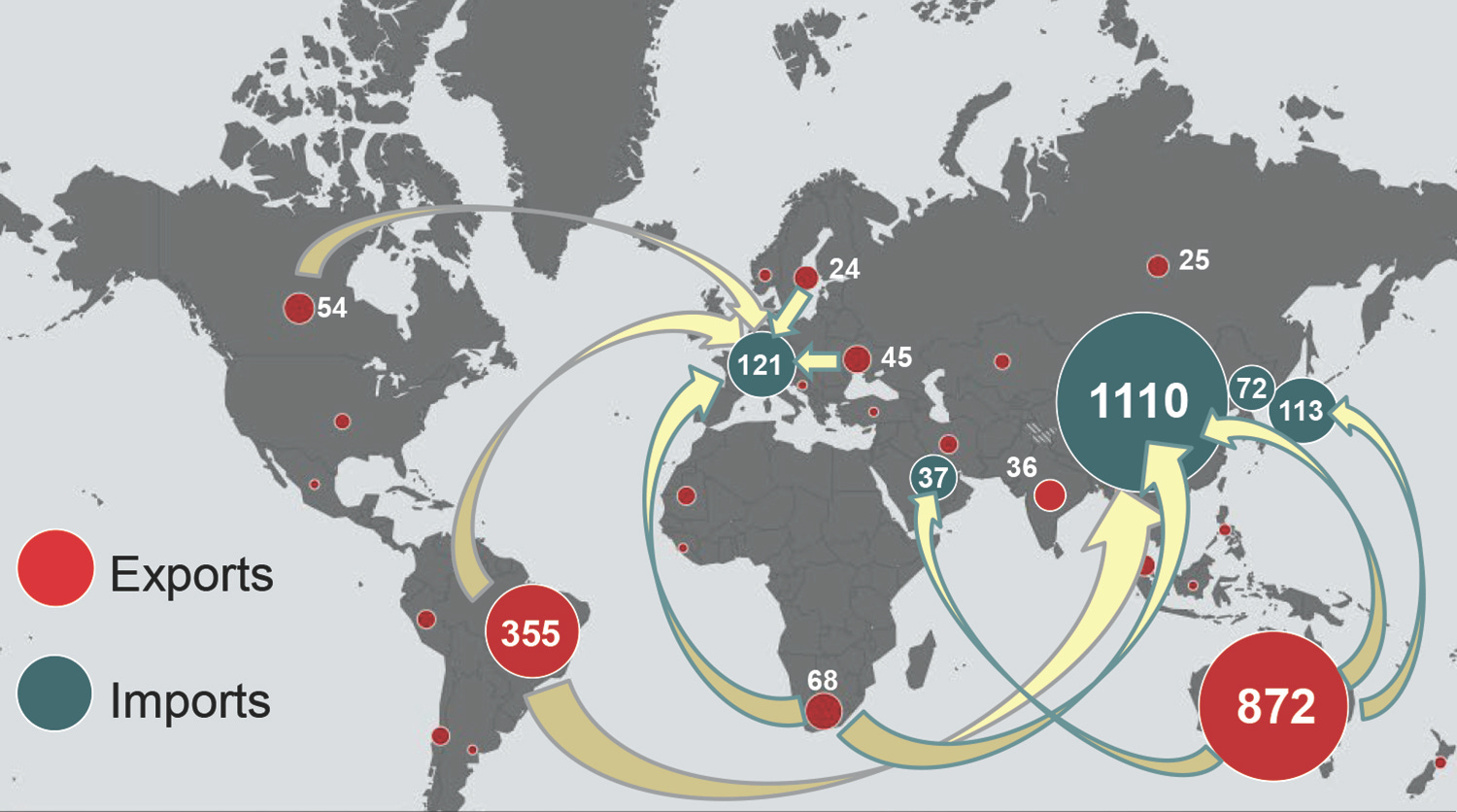
Iron ore rates have traded largely flat since the start of the conflict. As we see in the diagram, Brazil to China and Australia to China shipments completely circumvent the middle east. Iron ore is safe from the conflict, but let’s look at other raw goods.
Coal has two sides to it, thermal generation and mettalurgical (met) for steelmaking.
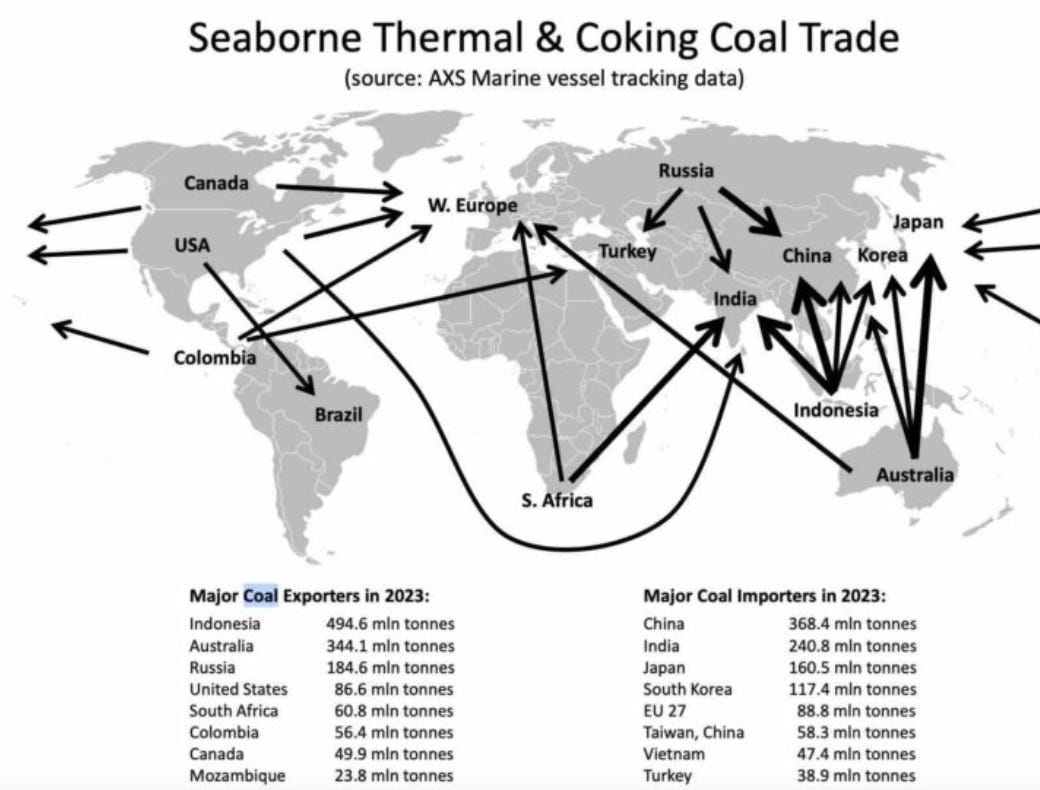
Coal is more interesting, less due to the trading routes, but more due to the demand impact. On account of oil and LNG no longer being accessible, thermal coal demand in southeast asia has skyrocketed. At the same time, trade routes are remapping.
As opposed to the usual Indonesia to China, the panamax tonne routes are falling by over 20%. While australia to south china almost doubled. Buyers are pulling more from Australia, making larger ships are more preferred. Longer trip means more ton-miles which means bigger ship = better ship. The reshuffling isn’t due to Australian coal being better. It’s because the middle east is a major producer of petroleum coke (petcoke), which is a direct competitor with thermal coal when it comes to Indian cement producers and Chinese industrial firms.
With the Hormuz closed, gulf petcoke can’t move. Indian and Chinese buyers switch to coal, and since Indonesian coal is typically cheaper and closer, demand was quickly driven up. Indonesian to Asian markets prices were driven up to the point that their cost advantage was eliminated. So, Australian coal is all the rage now.
All this has had a massive impact on coal prices, being driven up almost 40% since February lows. This impacts everything from power generation to steel, and it is not slowing down.
Grain and Fertilizers
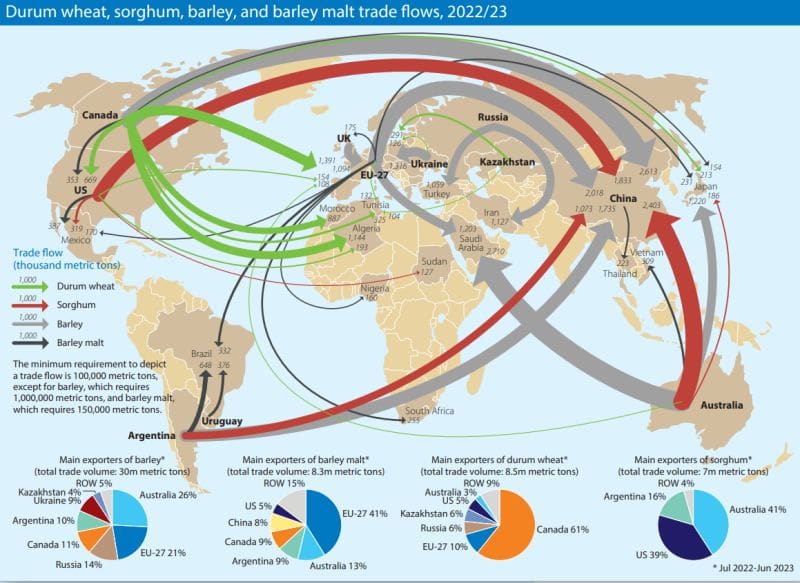
The grain situation is pretty alarming. While the strait only accounts for 5% of world grain movements, it accounts for pretty much all of middle eastern grain supply, especially Iran. Gulf states also import heavily, per capita wheat consumption there exceeds 100kgs yearly. That is a LOT of wheat. These inbound flows are blocked, restricted, or more expensive. Especially in Iran, where the main food supply of 93 million people is now blocked.
Up almost 20% since February lows, grain prices are a flow through to food and a gigantic flow through to inflation. Everything will be more expensive than we want it to be.
Grain is one thing, maybe it can be substituted with rice, oats, but what’s really been impacted are fertilizers. The Middle East Gulf accounts for roughly 25% of global seaborne nitrogen fertilizer exports, and the blockade is bottlenecking outbound fertilizer exports. Wheat supply is ample, but the key risk is demand destruction, grain trade should rebound quickly once hostilities end, but fertilizer markets will not.
The Hormuz crisis coincides with spring planting across hundreds of millions of acres of global cropland. Staple grains like maize, rice and wheat can require hundreds of kilograms of urea per hectare at maximum yield. Miss the planting window without fertilizer and you don't find out until harvest, six to nine months later.
That leaves India, Southeast Asia, Eastern Asia and countless developing markets to be potentially priced out of planting. Billions of people are facing a food crisis. While western markets can push through with some government help or larger cash reserves, the inflation still isn’t pleasant.
Urea (a common fertilizer) has evened out in pricing, but at one point was 75% above February lows. According to the western producer:
“Ammonia from northwestern Europe had been trading at a huge premium to product from India before the start of the Iran war due to the lingering impact of the Russia-Ukraine conflict, which drove up natural gas prices in Europe.
That premium has evaporated because India typically buys 1.9 million tonnes, or 80 per cent, of its annual supplies from the Middle East. It is used to make phosphate fertilizers.
If exports remain curtailed, prices in India could easily reach US$1,000 per ton, which would be double what they were before the hostilities.”
Since ammonia is another critical fertilizer, this is no good for anybody who likes to eat food and not pay obscene amounts for it.
How Rates Work — The BDI
Every day, shipowners with vessels and charterers (mining companies, commodity traders, grain houses) negotiate the cost of moving cargo. More cargo than ships, rates go up. More ships than cargo, they collapse. The swings are unlike almost any other market because of its daily negotiation, it’s like futures!
The Baltic Dry Index is how the world tracks this. Published daily by the Baltic Exchange in London, it’s a weighted composite of charter rates across the major vessel classes on specific benchmark routes. Brazil to China for iron ore, U.S. Gulf to Southeast Asia for grain. It’s not a financial construct. It’s the actual cost of hiring a ship today.
That’’s what makes it such a lovely indicator. It is not some fancy financial instrument based off of future growth rates or expectations, it’s literally the price TODAY! It moves in real time with physical demand and it’s nearly impossible to manipulate.
The volatility is fairly structural due to the volume involved. Ships take years to build, so supply adjusts slowly. Demand can shift in weeks. The BDI fell 94% between 2008 and 2012. It has tripled off its 2016 lows. These are pretty darn big movements.
Alongside the BDI, one mechanic worth understanding is ton-miles. Rates aren’t just about how much cargo moves, they’re about how far it travels. Force ships onto longer routes and each vessel spends more time at sea, effectively tightening supply even if total cargo volume is flat. That’s how a single closed strait can hurt cargo volumes and support freight rates at the same time.
What’s It To Ya
The BDI is easy to dismiss as a niche market indicator, something traders watch, not something that touches daily life. The chain from shipping rates to your grocery bill is shorter than it looks.
U.S. CPI hit 3.8% year-on-year in April, with energy accounting for over 40% of the monthly increase. Food prices are running 3.2% above a year ago. Some of that is direct energy pass-through. The Strait of Hormuz is 21 miles wide at its narrowest point. When it closes, the BDI is the first thing that moves. Everything else follows, slowly.
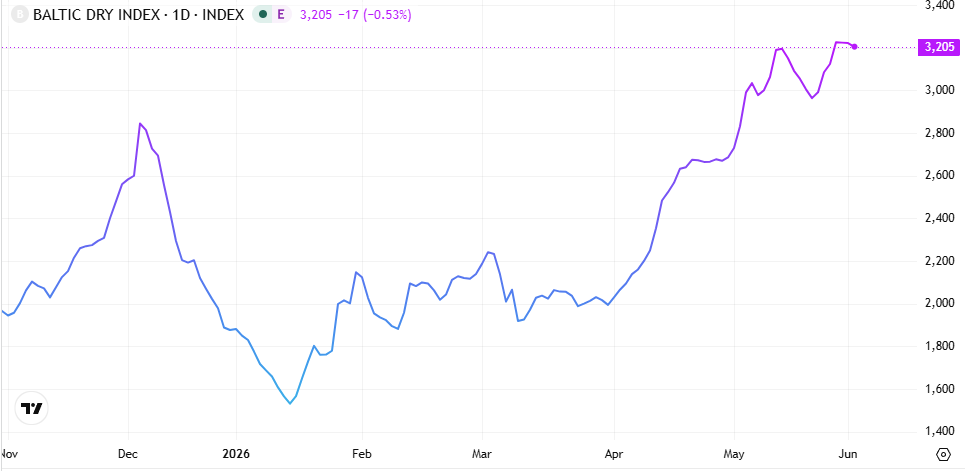
Up almost 50% since February lows, there is a lag so long that people may forget to make the connection, but the BDI seeps through to everything. I think the market isn’t pricing the impact quite correctly, and inflation, frankly, is going to suck.
I hope this helped clear the fog for you.